
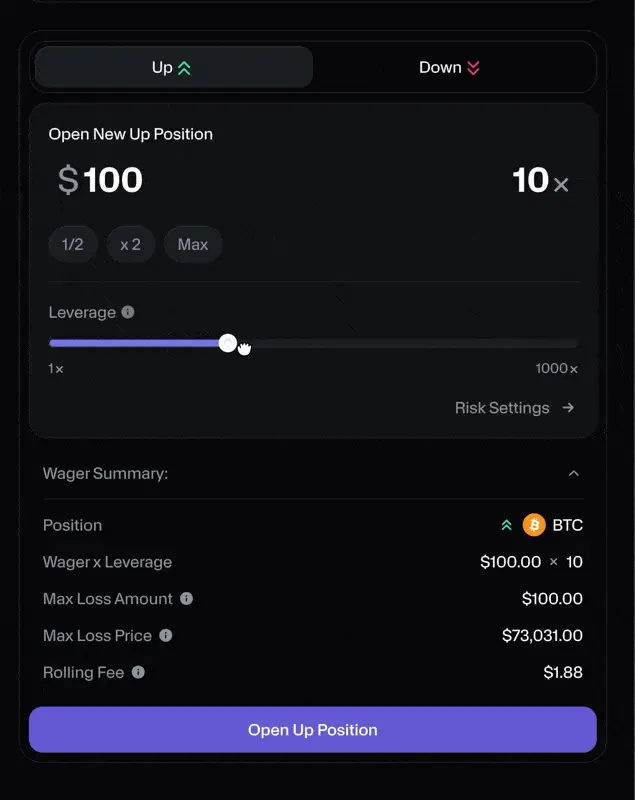
Crypto leverage on Moon.com multiplies the market exposure created by a wager. A $10 wager at 20x represents a $200 position. Larger leverage magnifies gains and losses and moves the Bust Price closer to the entry price; it does not turn a directional guess into an investment in the underlying coin.
Moon.com presents leveraged bets on whether a referenced crypto price will move Up or Down. The user does not purchase or custody Bitcoin, Ether or another asset. This distinction matters: the wager is a time-sensitive speculative bet whose result depends on entry price, direction, leverage, fees and exit.
How Moon.com leverage works
The core relationship is straightforward: position size = wager × leverage. Moon's current help material describes selectable leverage from 1x to 1000x where available. The live range can vary by market, jurisdiction and product settings.
| Wager | Leverage | Position size | Approx. move against direction to lose wager* |
|---|---|---|---|
| $10 | 1x | $10 | About 100% |
| $10 | 10x | $100 | About 10% |
| $10 | 100x | $1,000 | About 1% |
| $10 | 1000x | $10,000 | About 0.1% |
*Simplified illustration before fees, execution effects and platform rules. Always use the live Bust Price shown in the bet summary.
What the Bust Price means
Moon.com calls the automatic loss threshold the Bust Price or Max Loss Price. If the referenced market reaches that level against the chosen direction, the platform closes the bet and the wager is lost. Increasing leverage generally brings this threshold closer to the entry price.
An Up bet busts after a sufficient fall. A Down bet busts after a sufficient rise. Crypto markets can move sharply in seconds, so a threshold that looks distant on a calm chart may be reached during a volatile candle, news event or liquidity shock.
A worked leverage example
Suppose Bitcoin is referenced at $100,000 and a user places a $20 Up wager at 25x. The position size is $500. If the reference price rises by 1%, the gross change in the leveraged position is approximately 25% of the wager, before fees and execution. If price falls by 1%, the effect is approximately the same magnitude in the opposite direction.
This is an educational approximation, not a payout quote. The live ticket is the authoritative place to review entry price, position size, fee, payout and Bust Price.
Leverage does not improve the prediction
It only changes sensitivity. A weak directional thesis remains weak at 100x; it simply reaches a large gain or total loss after a smaller price movement. Good interface discipline is therefore more useful than chasing the largest multiplier.
How fees affect a leveraged bet
Moon's current fee guide describes an opening fee based on the wager and a performance fee applied to profit. It says losing bets do not incur a performance fee. Fee terms can change, so check the live summary and the latest official fee page before confirming.
Because leverage makes small moves meaningful, costs can matter disproportionately on short-lived bets. Compare the move needed to cover fees with the distance to the Bust Price rather than looking only at a possible headline payout.
Pre-bet leverage checklist
- Define the wager first. Treat it as money that can be lost in full; do not select leverage before deciding the risk amount.
- Read the position size. Confirm what market exposure the wager and multiplier create together.
- Locate the Bust Price. Compare its distance with normal recent volatility, not with a hoped-for direction.
- Review all costs. Check the opening fee, potential performance fee and current payout assumptions.
- Plan the exit. Decide in advance when to close, and avoid adding funds or immediately re-entering to chase a loss.
New users can rehearse the controls using Moon.com Play Money. Simulated funds cannot remove market uncertainty, but they can reveal how leverage, Bust Price and exit controls behave without risking real money.
Review the live ticket before continuing
Availability, leverage limits, fees and eligibility may differ. Check every value on Moon.com and use only an amount you can afford to lose.
Visit Moon.com ↗Sponsored affiliate link. 18+ and eligibility restrictions apply. High-risk speculative entertainment.Frequently asked questions
What is crypto leverage on Moon.com?
It is a multiplier applied to the exposure created by a wager. Moon describes position size as wager multiplied by leverage.
Can a Moon.com bet lose more than the wager?
Moon's current documentation says the maximum loss on an individual bet is capped at the wager. That does not prevent a series of bets from losing more in total.
What is the Bust Price?
It is the adverse reference price at which the bet closes automatically and the full wager is lost.
Is high leverage safer with a small wager?
A smaller wager caps the currency amount at risk on that bet, but high leverage still makes the position extremely sensitive to small price moves.