
On Moon.com, choose Up when the bet should benefit from Bitcoin rising after entry, or Down when it should benefit from Bitcoin falling. The opposite move creates a loss. Leverage magnifies both outcomes, and the adverse Bust Price can close the bet automatically.
Bitcoin Up vs Down
| Question | Up | Down |
|---|---|---|
| Profits when | Reference price rises from entry | Reference price falls from entry |
| Loses when | Reference price falls | Reference price rises |
| Bust threshold | Below entry | Above entry |
| Inherent safety advantage | None | None |
The mechanics are mirror images, but market behavior is not always symmetrical. Bitcoin can fall sharply during liquidations and rise sharply during squeezes. Either direction can hit a nearby Bust Price when leverage is high.
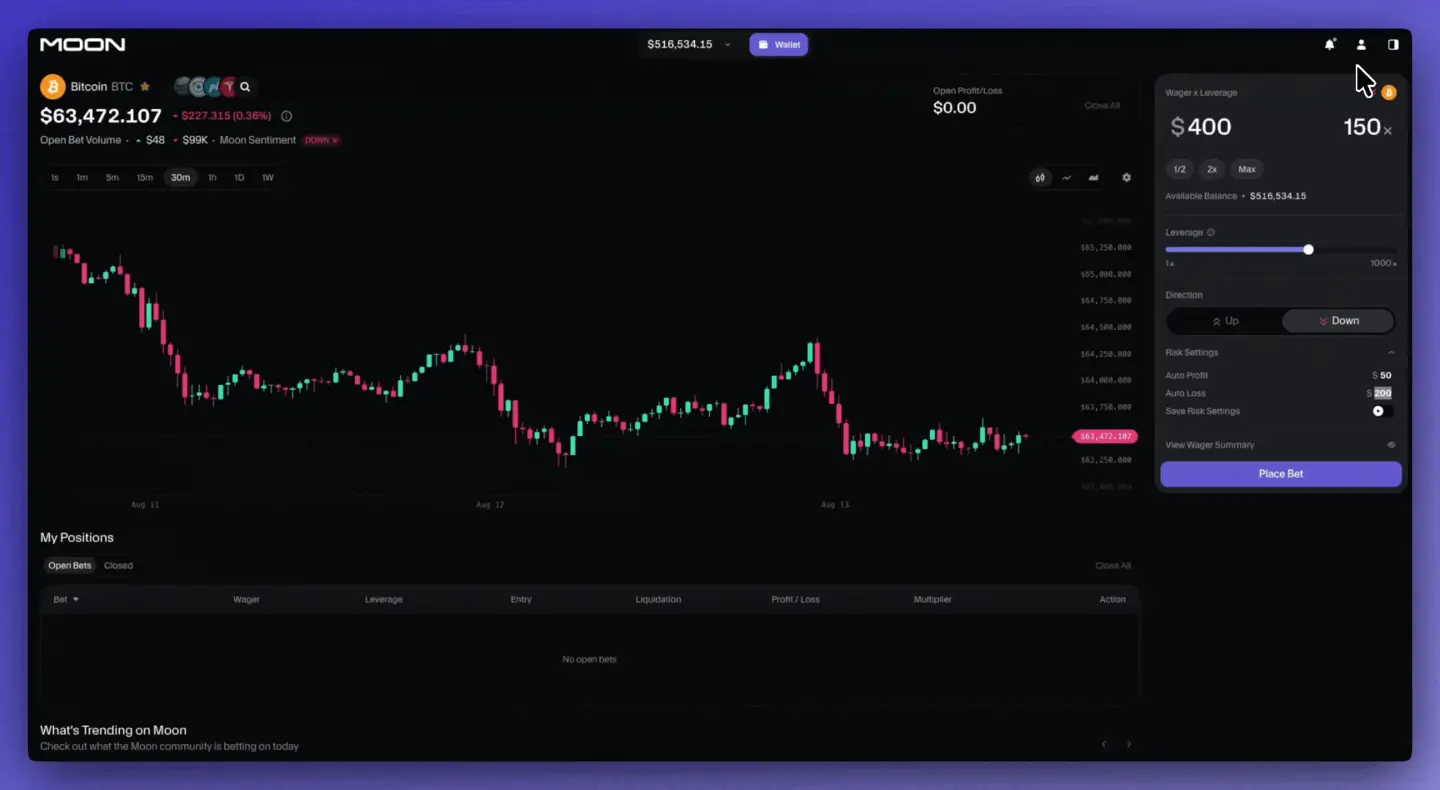
Why the entry price matters
Direction is measured from the ticket's reference entry—not from yesterday's close, a social-media chart or a price on another exchange. A user can be broadly right about Bitcoin over a week and still lose a highly leveraged bet opened at the wrong moment.
Moon says it aggregates independent market data and identifies DXFeed and Pyth Network in its data-feed materials. Small differences from other platforms can occur, so use the Moon ticket's own entry and live reference price.
Same market view, different timing
Suppose a user expects BTC to rise over several days but opens a 100x Up bet minutes before a 1% pullback. The longer-term view may later prove correct, while the short-lived leveraged ticket has already busted. A direction without a timeframe is incomplete.
How leverage changes both directions
Leverage increases the position size created by a wager and brings the adverse Bust Price closer. At 10x, a roughly 10% adverse move may consume the wager in a simplified model; at 100x, roughly 1%; at 1000x, roughly 0.1%. Fees and live platform calculations also apply.
Volatility and timeframe scenarios
| Scenario | What can happen | Risk question |
|---|---|---|
| Short burst | A rapid move can help one direction and bust the other before there is time to react. | Is the Bust Price inside normal minute-to-minute volatility? |
| Sideways chop | Price repeatedly crosses the entry while fees and impulsive flips erode discipline. | Is there a time-based exit? |
| News shock | Both upside and downside volatility can expand suddenly. | Should the bet be open during the event? |
| Overnight exposure | Bitcoin trades while the user is not monitoring the ticket. | Can the position be left unattended? |
No indicator or timeframe guarantees the next move. This page deliberately does not predict Bitcoin's direction. Its purpose is to make the ticket mechanics and failure modes explicit.
A direction decision checklist
- State the direction in one sentence. If the reason is only “it has to go up/down,” there is no testable plan.
- Define the timeframe. Decide whether the idea concerns minutes, hours or longer—and whether the selected leverage is compatible.
- Read the Bust Price. Compare it with recent BTC volatility and plausible intraday moves.
- Set the exit before entry. Specify a profit, loss or time condition. Do not improvise after emotions take over.
- Use Play Money for rehearsal. Test both Up and Down with identical settings to see how their P/L responds.
For the complete ticket workflow, see how to bet on Bitcoin on Moon.com. For position-size mechanics, read our crypto leverage guide.
Inspect the live direction ticket
Check the current entry, leverage, fee, payout and Bust Price on Moon.com. Never interpret this guide as a Bitcoin price prediction.
Visit Moon.com ↗Sponsored affiliate link. 18+ and eligibility restrictions apply. High-risk speculative entertainment.Frequently asked questions
What does Up mean on Moon.com?
Up benefits when the referenced Bitcoin price rises from entry and loses when it falls.
What does Down mean on Moon.com?
Down benefits when the referenced Bitcoin price falls from entry and loses when it rises.
Is Up safer than Down for Bitcoin?
No. Risk depends on the actual move, wager, leverage, Bust Price and time exposure—not merely the direction label.
Does this guide predict whether Bitcoin will go Up or Down?
No. It explains product mechanics and risk only; it provides no market prediction or financial advice.